Wednesday, November 21, 2012

Midwest Regionals


At the regional meet, all we wanted was to get top 2 and qualify automatically to NCAA’s. This was not a task that we took lightly; including us, we had three top-10 teams in OSU, us, and Tulsa. We all had good races and we all stepped up to tie OSU for the win. This ended up being a lucky break, since Tulsa really rose to the challenge was only two points behind us in third. 
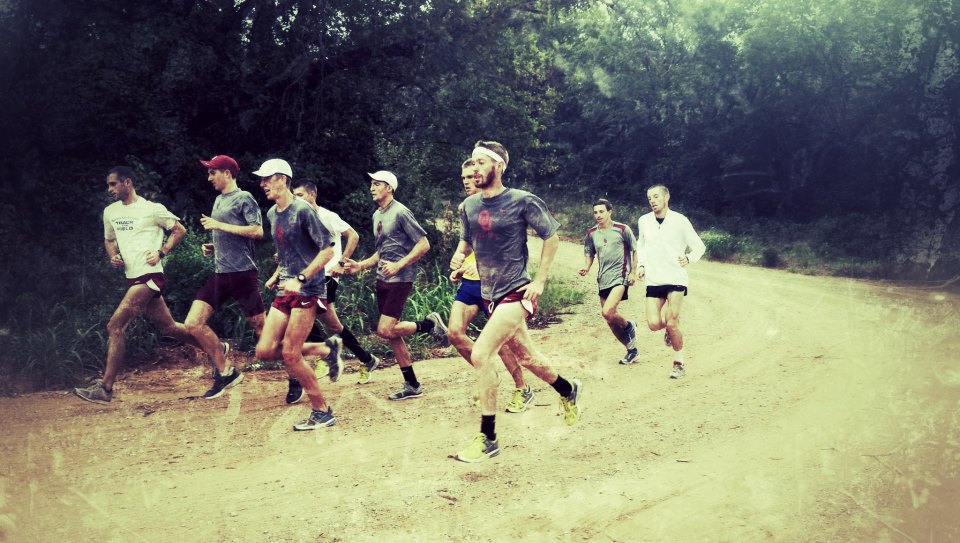
Keeping the pack together
The scores for top 3 were 45-45-47 and it was a real nailbiter when the results were being tallied. Of course, Tulsa ended up going to NCAA’s anyway as an at-large qualifier, but it was great to have the momentum of winning regionals going into the national meet. Our top 6 all scored in the top 20 and this ended up being our most satisfying meet. We executed the race plan perfectly and left knowing that all we had to do at nationals was replicate our tactics and we would run to our potential as a team. 

Happy with the win

Big 12's


We entered the post-season with our next race, the Big 12 meet in Austin. Our team goal in this race was to get a solid 2nd behind OSU and ahead of Texas. Challenging OSU is always a nice goal, but in hindsight they were dominant this year. Again, we didn’t run the way we wanted to and it ended up biting us as we got 3rd, losing to Texas. Partly because Texas really stepped up and we just had a regular day, they beat us by 6 points and moved ahead of us in the rankings. This was our most disappointing meet because we should have been able to get 2nd overall. This race was a learning experience to improve on, but still a tough loss.

Just after the start

Wisconsin


Three weeks later, we raced at the Wisconsin Invitational. Over the past couple of years this has been the biggest meet in the regular season, and probably the hardest field besides NCAA’s. This year was crazy with something like 45 teams in the field (Mick Byrne said after the race that he’ll limit entry to 30 or so because the field was just too big). We were optimistic about this race and thought that if we executed the pack running concept as well as we did at UVA, then we should be able to win. Well, the race went about as weirdly as anyone had ever seen a big cross country race go. Instead of going out fast and then settling in, everyone went out slow for the first two miles and then hammered the last half. 

I'm back there somewhere, I promise
The big move at 3k split us up and we ended up not running our plan, and so we didn’t run as well as we wanted to. We got 3rd in the meet behind Stanford and Iona and were disappointed as a team, although some guys had great races. It was a good learning experience and we did our best to objectively look at our mistakes and fix them for the post-season. Even though Wisconsin was such a big meet, it was still regular season so it didn’t count for much besides a rehearsal for NCAA’s.

Panorama Farms


Our first test came at the UVA Panorama Farms Invitational on September 22. Despite the early season and relatively low-key meet, there were some good teams there including us, Michigan, Arkansas and the host school Virginia. All four made it to NCAA’s so it was actually a solid field. Our goal was to run as a five-man pack for the whole race and win it, which we did comfortably. The course was challenging and we succeeded because we dictated the race instead of letting the race dictate us. The other teams didn’t run as smart and so they didn’t run to their potential like we did. Overall we were happy with this race since we accomplished our plan and it was a good fitness checkpoint for us.

Some strides before the start

Cross Country 2012 Recap


My last cross country season is in the books and I’m at home for Thanksgiving, so I have time to reflect on the last few months, and what better place to do that than here? Now that the season is over I’ll talk about the five major races we competed in and analyze them in the context of what we were trying to achieve as a team. The team has finished 6th and 5th at NCAA’s the past two years, so the next logical step for the program this year was to finish 4th or better. Everything was done with this goal in mind.


Friday, August 17, 2012

Oklahoma

I know I haven't updated on anything in a while, but that was both intentional and a necessity. I had a good summer of training with some good guys in a location very conducive to running, and now I'm finally in Norman, OK at the University of Oklahoma. I'm in the midst of the necessary school and NCAA meetings and other red tape, but once this is over we start practice and get the season going in earnest.

I don't have much that I can say in the public domain, other than the team has a bunch of great guys and we are ready to have a great year. Of course, all of other top 10 teams in the country are saying that right now too.

The weather has been pretty forgiving and it's not too bad to run at either end of the day, though I'm sure that will get worse before it gets better.

It will be quite the adjustment being so far away from home for nine months but I know it will be worth it in the end. I can't wait to see how all of our training pays off when it comes time to put it all on the line in November!

Wednesday, June 6, 2012

Back to Summer Training

Last week was my first full week of real summer training. To me, summer training, and off-season training in general, is the most important training phase of the year. Lydiard wasn't kidding when he said that the base phase determines your performance level for the entire training cycle.

I think a lot of people either don't conceptualize or just don't understand summer training. In high school I just did easy runs for three months, came into preseason and started working out. I never ran as well in cross country as I did in track, and it's clear to me that it's because I let myself lose too much fitness over the summer. I would come into mid-August having run a lot of 60 mile weeks, but never run anything harder than easy runs. In the winter, I did long intervals and occasional tempo runs and always ran much better in May than I did in November. Last year, I had the best fall season of my life and I think a lot of it was because I decided to run a half marathon in mid-September. That forced me to get in good shape for that starting earlier than I ever had, and that fitness carried through for arguably the rest of the year.

Canova says that 80% of training is just training to train. By that he means that 80% of training could be considered foundation work for the highly specific workouts in the two months or so before a peak. Summer training for cross country is exclusively training to train. The whole point is to get your body ready to start working out and racing come September. It is a time for building strength and a big endurance base.

And now we arrive back at the big mistake: people don't have the right idea of what endurance means. Endurance training is by far the most general of the phases. It is an almost intentional lack of specificity. Over 50 years ago Lydiard showed everyone that endurance training works for every race 800m and up (unless the 800 guy is a sprinter moving up, then it probably wouldn't work very well). A lot of people also misunderstand Lydiard's base phase. It is NOT easy running; it is "steady running," and he set 100 mpw as a benchmark. That is really really hard to do, and it's also the main reason (along with periodization) why his principles are behind so many gold medal performances.

And finally on to what is the right way to train in the summer. I guess this is more accurately what I think is the best way to train in the off-season, since I'm not stupid enough to think I've got it all figured out. Part 1 lasts until you get up to whatever your desired peak mileage is. In my opinion it is best to get there sooner rather than later to give your body time to adjust to the workload before introducing another stimulus, i.e. workouts. Part 2 lasts for the rest of the summer, and consists of long tempo runs and intervals. These form a good mental break from the easy runs and are really the immediate precursor to XC-specific workouts.

Other stuff: I like to do hillsprints when I feel motivated enough. These are another thing a lot of people do wrong, because no one is really patient enough to do them with enough recovery. I'm not an expert but Canova is the authority on them and why they're a good idea. Bodyweight exercises and drills are probably a good idea too, if nothing else to strengthen your core and keep your form from getting too sloppy. Hitting the weight room for the compound lifts is good if you can find the time, but know what you're doing before you try and squat 300 and kill yourself.